
 |
| Rock Bridge, Red River Gorge, KY. Where's Waldo, Where's Tracy? |
Friday, September 30, 2011

Thursday, September 29, 2011
Leave No Trace in Practice on the Appalachian Trail

Earlier this year, we met Buckeye Flash, who was planning on hiking the Appalachian Trail. He completed his journey earlier this month and we asked him to explain how he used Leave No Trace while on the trail:
On March 22, 2011, I began my attempt to thru-hike the 2,181-mile Appalachian Trail (AT). I started at Springer Mountain, Georgia (southern terminus) and hoped to reach Mt. Katahdin (northern terminus) in Baxter State Park in Maine before it closed in mid-October. To say that I was inexperienced would be a huge understatement. My previous hiking was basically limited to a dozen or so day-hikes of two to three hours per hike. As a hiker I had never spent one night camping. I came away with a new respect for the physical environment of the mountains and back country as a whole. A sense of stewardship by hikers is essential to the future of the trail.
Before the trek began I was introduced to Jason and Agata Ketterick, Traveling Trainers for Leave No Trace (LNT). They asked me to explain how my AT experience related to the principles of outdoor ethics which LNT promotes. So here is my story.

1. Plan ahead and prepare:
Before the hike I read as much as I could on the places where I would be hiking, such as, the Great Smoky Mountains National Park (GSMNP), Shenandoah National Park and Baxter State Park in Maine. An example of an important regulation in the GSMNP is that a hiker must stay in a shelter, if space is available. If there isn't space available in the shelter, tenting nearby is permitted. This type of information was helpful in knowing the dos and don'ts in those areas. Starting my hike in March meant having warmer clothing and a 30-degree sleeping bag at the start and subsequently replacing it with lighter weight clothing and a 45-degree sleeping bag later on.
2. Travel and camp on durable surfaces:
The AT has approximately 260 shelters between Georgia and Maine. A shelter may sleep 4 to 20 people. A source of water and a privy are available at almost every shelter. In addition at most shelters there are campsites. Most of the time I camped near the shelter. A few times the need arose to camp where there were no shelters nor campsites. On those occasions it was important to camp at least 200 feet from the source of water, such as a pond or stream. Walking in the middle of the AT is easy when the trail is dry. The difficult part is to stay in the middle of the trail when there is standing water or mud "blocking" the trail. Yet it may necessary in order not to damage the vegetation in pristine areas. I hiked alone for much of my trek. In the latter part of my journey I hiked with other people and during that time we always walked single file making it easier to stay on the trail.
3. Dispose of waste properly: A basic principle of LNT outdoor ethics is to pack out what you pack in. No one enjoys seeing trash on the trail, at a shelter or campsite. Most thru-hikers follow this principle religiously. Unfortunately there are the rare times when the principle is not followed and litter dots the ground. Several times I picked up a candy or snack wrapper which may have fallen out of a hiker's pack or pocket. One major advantage of staying at or camping near a shelter is the presence of a privy. It saves the need to dig a cat hole to dispose of human waste. I did very little cooking during my hike so I did not need to wash dishes often. When I did cook, I merely boiled water and poured it into a plastic pouch containing dehydrated food. After eating the food, the pouch was packed out as trash saving the need to wash dishes. The few times that I did need to wash a cup or bowl, I was careful to be 200 feet or more away from a water source and use only a drop or two of biodegradable soap.
4. Leave what you find: I carried everything I needed on my back. I had no desire to take anything I saw or found on the trail as an artifact or souvenir.
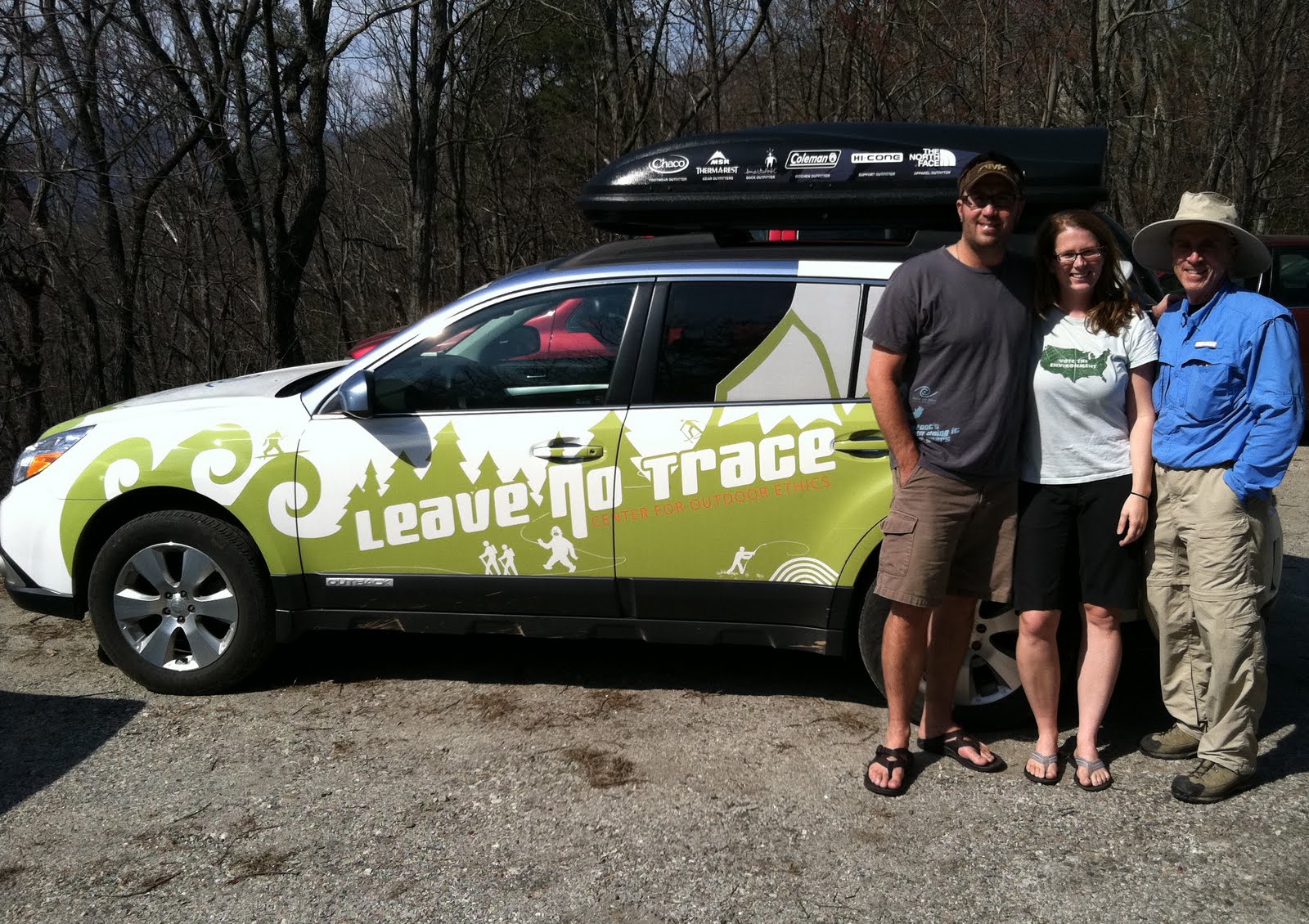
5. Minimize campfire impacts: At most shelters and campsites there are established fire rings. Thru-hikers who cook carry a small stove. So on the AT fires are not typically used for cooking. They do provide a place to socialize in the evening. In some areas, especially in the northeast US, there are signs which state that no fires are permitted. In some cases shelters have had to be rebuilt due to fires.
6. Respect wildlife: The point that one should observe wildlife from a distance is common sense. Bears, moose and snakes are generally not aggressive, if they are not followed or approached. I saw bear, moose, snakes and other animals on the AT. At no times were any aggressive. Storing food and trash securely is important. In many areas bear cables or bear boxes protect wildlife and hiker food. Most hikers who bring their dog on the trail have a well behaved pet. I did not observe any pet that was out of control. Dogs are not permitted though in the Smokies or Baxter State Park.
7. Be considerate of other visitors
I was impressed by how courteous most AT hikers were in yielding to others on the trail. Stepping to the side when encountering hikers was widely followed.
-Buckeye Flash
Buckeye Flash is the trail name of Bob Grau, a retired educator from Cleveland, Ohio. He finished his thru-hike at Mt. Katahdin in Maine on September 7, 2011. He hiked the last 350 miles on a broken ankle. Check out the blog he wrote while hiking the Appalachian Trail.
All the best,
Agata and Jason
Tuesday, September 27, 2011
Team West in the Sawtooth National Forest

Ketchum, Idaho -
Over the past week Team West has been enjoying world class outdoor recreation and educational outreach in the Sun Valley area. Teaming up with old friends at Mountain Niceness Productions, and meeting up with new ones like local outfitter Backwoods Mountain Sports we had the opportunity to get out into some of the most beautiful country we have seen in 2011!

The community in Sun Valley embraced the seven principles of Leave No Trace where ever we had the chance to connect and share the programs we offer on the road as Traveling Trainers. The ethic of stewardship for public land in places like the Sawtooth National Forest is apparent in the responsible actions and attitudes amongst all user groups we encountered.
Keep an eye out for Leave No Trace in Boise later this week as team West visits REI and offers a PEAK workshop on Wednesday evening.
All the best,
Jason and Agata
Monday, September 26, 2011
Red River Gorge-eous!
Stanton, KY. This past weekend marked the second consecutive year the Subaru/Leave No Trace Traveling Trainer program attended the Living Archeology Weekend at the scenic Red River Gorge in the Daniel Boone National Forest. Known for its abundant natural stone arches, unusual rock formations, and spectacular sandstone cliffs, the Red River Gorge has been designated a geological area by the Forest Service.

 |
| Sky Bridge |
In 2010, the Red River Gorge was named as the very first Leave No Trace Hot Spot. A Leave No Trace Hot Spot is an are that is impacted by litter, dog waste, invasive species, habituated wildlife, trail and campsite erosion, contamination of water sources, names carved in trees, cigarette butts along a trail, damaged cultural and historic sites, toilet paper “flowers” around campsites and pets chasing wildlife. Once a site is nominated and selected, The Center seeks to minimize these common impacts through outreach, education, training, signage, educational materials, consulting and local collaboration. One year later, both the Center and Forest Rangers that we spoke to are pleased with the progress of the program.
 |
| Leave No Trace Signage at the Gladie Visitor Center |
This year, Team East returned to the gorge for a weekend of education and outreach. On Friday, we were stationed at the Gladie Visitor Center. We met with more than 800 fifth graders, teachers, and their chaperones to stress the importance of the Leave No Trace Principle Leave What You Find. Throughout the course of the day, there were many "lightbulb" moments for the students. They understood that if past generations had removed cultural items from the natural world, today we would have a lesser understanding of our cultural history. Looking to the future, the students were also empathetic to the idea that if were on a hike today and removed arrowheads, artifacts, and other historical items from the natural world, then future generations will not be able to study the historical significance of these cultural areas either. Lightbulbs were, indeed, turning on left and right for these young stewards of the land!
 |
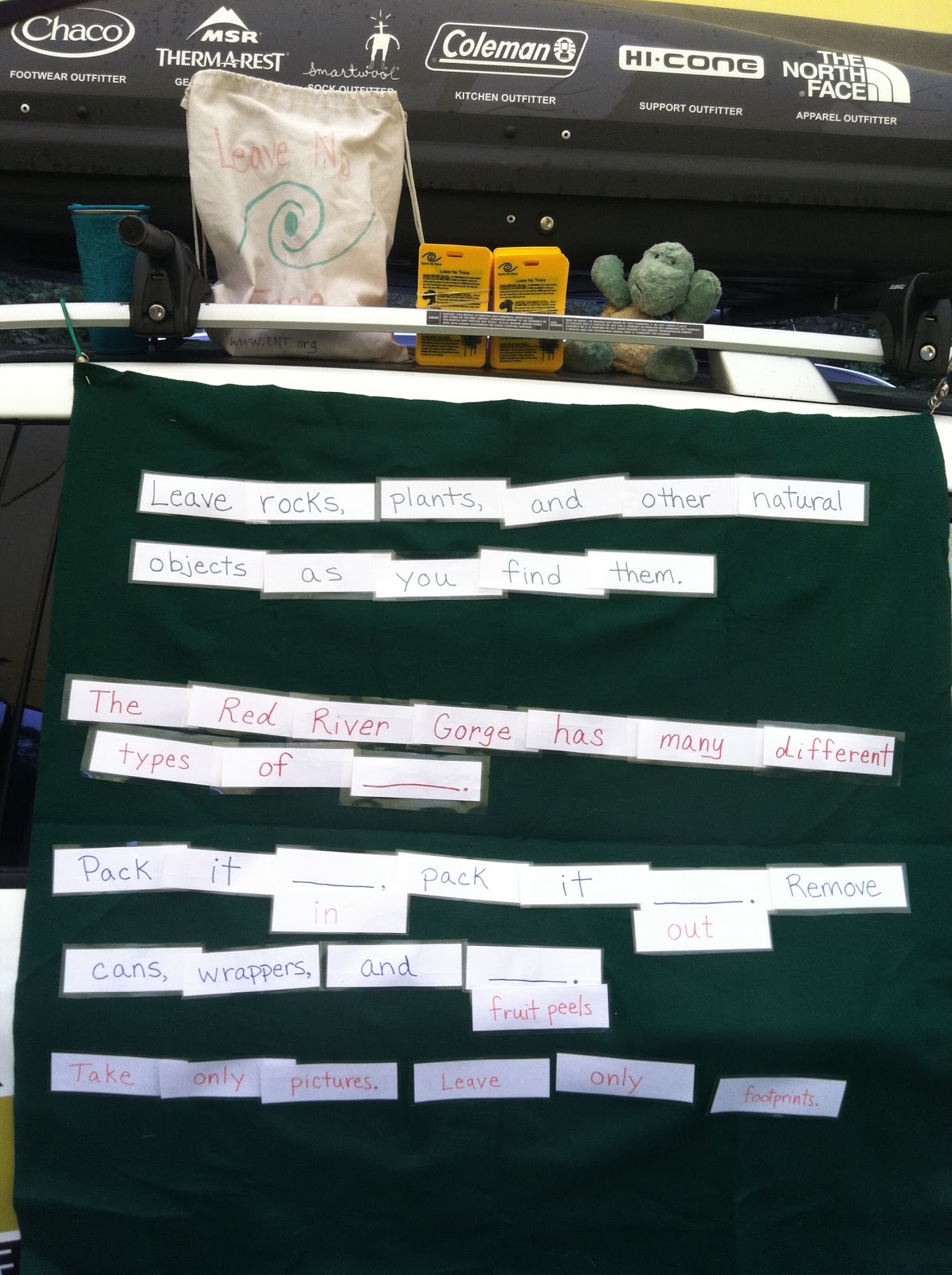
Above, students work on the activity "Sentence Frenzy" to understand the importance of preserving and protecting the cultural resource in their own back yards. Our next stop is Lake Barkley State Resort Park for a trainer course with the Kentucky State Parks. Team East signing off from the Bluegrass State!
Explore Responsibly...Kate and Tracy
Explore Responsibly...Kate and Tracy
Friday, September 23, 2011

Thursday, September 22, 2011
Smartwool & Soda Creek in Steamboat Springs

Steamboat Springs, CO - Earlier this week we visited Smartwool, one of the official outfitters of the Subaru/Leave No Trace Traveling Trainer program. Fifteen Smartwool employees joined us for an opportunity to learn more about Leave No Trace and a barbeque. The conversation focused on how to share the 7 program principles with audiences in any setting where promoting responsible outdoor recreation is possible.
 We also had the chance to visit all of the 5th graders at Soda Creek Elementary School and introduce these young outdoor recreationists to the concepts of the Leave No Trace program. The students were very excited to talk about making safe and responsible decisions in the outdoors as well as taking the BigFoot Challenge on the Leave No Trace website!
All the best,
Agata and Jason
Wednesday, September 21, 2011
Gorge Hoppin' in the Southeast!
 |
| Gauley River |
Explore Responsibly...Kate and Tracy
Subscribe to:
Posts (Atom)



 Posts
Posts


